PTO Accrual Calculator
PTO per pay period = annual PTO hours ÷ pay periods per year. Work out PTO per paycheck, per hour worked, your balance with a 12-month projection, paid sick leave by state and PTO payout, in hours or days.
PTO per pay period
Spread a yearly PTO allowance across your paychecks.
PTO per hour worked
For policies like “1 hour of PTO for every 30 hours worked”.
PTO balance and projection
PTO is added after each full pay period from the start date.
Paid sick leave by state
Minimum accrual under state law. Your employer can give more.
PTO payout
What unused PTO is worth when it is cashed out.
PTO per biweekly paycheck
4.62 h
120 hours of PTO a year
PTO earned per week
1.33 h
Current PTO balance
82.00 h
| Date | Balance | Chart |
|---|
Projection for the next 12 months, assuming no more PTO is used.
Sick leave earned per week
1.33 h
PTO payout before taxes
$1,000.00
Payouts are usually taxed as supplemental wages. Whether unused PTO must be paid out depends on your state and your employer’s written policy.
Stop recalculating PTO every payday. TimeCamp accrues it automatically from your policy.
For planning only, not legal advice. Check your state labor department and local ordinances.
How to use the PTO accrual calculator
How to calculate PTO accrual
To calculate PTO accrual, spread the yearly PTO allowance over the time it is earned: per pay period, per hour worked, or as a lump sum at the start of the year. Use the method your policy names, then apply its formula.
Method 1: per pay period
Convert the allowance to hours and divide it by the number of paychecks in a year.
PTO per pay period = annual PTO hours ÷ pay periods per yearExample: 15 days × 8 hours = 120 hours a year. Paid every 2 weeks (26 paychecks), the employee earns 120 ÷ 26 = 4.62 hours per paycheck. Paid monthly, it is 10.00 hours.
Method 2: per hour worked
Common for hourly and part-time staff, and the method most state sick leave laws use.
PTO earned = hours worked × (PTO hours ÷ hours worked to earn them)Example: at 1 hour of PTO for every 30 hours worked, a 40-hour week earns 1.33 hours, or 69.33 hours over a 2,080-hour year.
Method 3: lump sum (frontloading)
The whole allowance is available on the first day of the year, and new hires usually get a prorated share.
Prorated PTO = annual PTO hours × months left in the year ÷ 12Example: an employee with 120 hours a year who starts on July 1 gets 120 × 6 ÷ 12 = 60 hours for the rest of the year.
PTO accrual per pay period
PTO per pay period is the annual allowance in hours divided by 52 weekly, 26 biweekly, 24 semi-monthly or 12 monthly paychecks. With 15 days of PTO and 8-hour days, that is 2.31, 4.62, 5.00 or 10.00 hours per paycheck. The table covers the most common allowances.
| Annual PTO | Weekly (52) | Biweekly (26) | Semi-monthly (24) | Monthly (12) |
|---|---|---|---|---|
| 10 days (80 h) | 1.54 h | 3.08 h | 3.33 h | 6.67 h |
| 15 days (120 h) | 2.31 h | 4.62 h | 5.00 h | 10.00 h |
| 20 days (160 h) | 3.08 h | 6.15 h | 6.67 h | 13.33 h |
| 25 days (200 h) | 3.85 h | 7.69 h | 8.33 h | 16.67 h |
PTO accrual per hour worked
PTO per hour worked is the PTO you earn divided by the hours you must work to earn it. At 1 hour for every 30 hours worked, the rate is 0.0333 hours of PTO per hour, so a 40-hour week earns 1.33 hours of PTO.
| Hours worked per week | PTO per week | PTO per year |
|---|---|---|
| 20 h | 0.67 h | 34.67 h |
| 30 h | 1.00 h | 52.00 h |
| 40 h | 1.33 h | 69.33 h |
How long does it take to accrue 40 hours of PTO?
At 1 hour of PTO per 30 hours worked, 40 hours of PTO takes 1,200 hours of work. That is 30 weeks at 40 hours a week, or 40 weeks at 30 hours a week.
Accrual based on hours worked? Let AI fill the timesheet.
PTO earned per hour is only as accurate as the hours in your timesheet. TimeCamp’s AI Time Tracker works in the background, suggests time entries for your projects and lets you approve them in about 2 minutes a day. Screenshots are processed on your device and never shown to managers. Learn more about AI Time Tracker
Download for
No signup needed to use the AI Time Tracker. Free account unlocks all of TimeCamp.
 user reviews
 4.7
 G2user reviews4.7
 user reviews4.7
PTO hours to days
40 hours of PTO is 5 days at 8 hours a day. To convert PTO hours to days, divide the hours by the length of your workday; with 7.5-hour days, the same 40 hours is 5.33 days.
| PTO hours | Days at 7.5 h a day | Days at 8 h a day |
|---|---|---|
| 8 h | 1.07 | 1 |
| 16 h | 2.13 | 2 |
| 24 h | 3.20 | 3 |
| 40 h | 5.33 | 5 |
| 80 h | 10.67 | 10 |
| 120 h | 16.00 | 15 |
Paid sick leave accrual by state
Most state paid sick leave laws require 1 hour of paid sick leave for every 30 hours worked, with a yearly limit that usually falls between 40 and 72 hours depending on the state and employer size. The table shows each state that requires paid sick leave (or paid leave that can be used for illness), with a link to the state agency.
As of October 23, 2026. Local laws (for example in cities and counties) can require more.
| State | Accrual rate | Yearly limit | Which employers | Source |
|---|---|---|---|---|
| Alaska | 1 h per 30 h worked | 56 h (15 or more employees); 40 h (fewer than 15 employees) | All employers (since July 1, 2025) | AK Dept. of Labor |
| Arizona | 1 h per 30 h worked | 40 h (15 or more employees); 24 h (fewer than 15 employees) | All employers | Industrial Commission of AZ |
| California | 1 h per 30 h worked | 80 h. Employers can limit use to 40 hours (5 days) a year. | All employers | CA Labor Commissioner |
| Colorado | 1 h per 30 h worked | 48 h | All employers | CDLE |
| Connecticut | 1 h per 30 h worked | 40 h | 11+ employees in 2026; all employers from January 1, 2027 | CT DOL |
| District of Columbia | 1 h per 37 h (100 or more employees); 1 h per 43 h (25 to 99 employees); 1 h per 87 h (24 or fewer employees) | 56 h (100 or more employees); 40 h (25 to 99 employees); 24 h (24 or fewer employees) | All employers; rate depends on size | DC DOES |
| Illinois | 1 h per 40 h worked | 40 h. Paid leave for any reason. Chicago and Cook County have their own rules. | All employers | IDOL |
| Maine | 1 h per 40 h worked | 40 h. Earned paid leave for any reason. | 10+ employees | Maine DOL |
| Maryland | 1 h per 30 h worked | 40 h. Employers with fewer than 15 employees must give the same time unpaid. | 15+ employees (paid) | MD Labor |
| Massachusetts | 1 h per 30 h worked | 40 h. Smaller employers must give the same time unpaid. | 11+ employees (paid) | Mass.gov |
| Michigan | 1 h per 30 h worked | 72 h (11 or more employees); 40 h (10 or fewer employees). Small employers must also allow 32 more hours unpaid. | All employers (ESTA) | MI LEO |
| Minnesota | 1 h per 30 h worked | 48 h. Balance can be capped at 80 hours. | All employers | MN DLI |
| Missouri | Not required | - | No statewide requirement: Proposition A was repealed, effective August 28, 2025 | MO Labor |
| Nebraska | 1 h per 30 h worked | 56 h (20 or more employees); 40 h (11 to 19 employees). Accrual starts after 80 hours of consecutive employment. Employers with 10 or fewer employees are exempt. | 11+ employees (since October 1, 2025) | NE DOL |
| Nevada | 0.01923 h per hour worked | 40 h. Paid leave for any reason, 0.01923 hours per hour worked. | 50+ employees | NV Labor Commissioner |
| New Jersey | 1 h per 30 h worked | 40 h | All employers | NJDOL |
| New Mexico | 1 h per 30 h worked | 64 h | All employers | NM DWS |
| New York | 1 h per 30 h worked | 56 h (100 or more employees); 40 h (5 to 99 employees); 40 h (4 or fewer employees (net income over $1M)). Employers with 4 or fewer employees and net income of $1M or less must give 40 hours unpaid. | All employers | NY DOL |
| Oregon | 1 h per 30 h worked | 40 h. 6+ employees in Portland. Smaller employers must give the time unpaid. | 10+ employees (paid) | BOLI |
| Rhode Island | 1 h per 35 h worked | 40 h. Smaller employers must give the time unpaid. | 18+ employees (paid) | RI DLT |
| Vermont | 1 h per 52 h worked | 40 h | All employers | VT DOL |
| Washington | 1 h per 40 h worked | No yearly cap. Up to 40 unused hours carry over to the next year. | All employers | WA L&I |
Managing PTO rules across several states?
See how TimeCamp applies different accrual rates, caps and carryover rules to each team during a live demo with our Specialists.
Book a demo

How much PTO is normal?
In US private industry, the average worker with paid vacation gets 11 days after 1 year of service and 20 days after 20 years, according to the Bureau of Labor Statistics (National Compensation Survey, March 2026). Paid holidays and sick leave usually come on top of vacation days.
| Length of service | Paid vacation days | In hours (8 h a day) | Per biweekly paycheck |
|---|---|---|---|
| After 1 year | 11 | 88 h | 3.38 h |
| After 5 years | 16 | 128 h | 4.92 h |
| After 10 years | 18 | 144 h | 5.54 h |
| After 20 years | 20 | 160 h | 6.15 h |
Private industry workers also received an average of 8 paid holidays in 2025, and 80 percent of them had access to paid sick leave (BLS, The Economics Daily, February 10, 2026). Private industry workers with paid sick leave get 7 sick days a year on average, at any length of service (BLS, March 2026).
Carryover, caps and PTO payout
Carryover lets unused PTO move into the next year, a cap limits how much PTO an employee can hold, and payout turns unused PTO into money, usually when someone leaves the company.
- Carryover (rollover): the hours that stay in the balance on January 1 or at the start of the benefit year. Policies often limit it, for example to 40 hours.
- Accrual cap: the most PTO an employee can hold. When the balance reaches the cap, accrual stops until some PTO is used. Many state sick leave laws allow caps, such as 80 hours in California.
- Use-it-or-lose-it: unused PTO expires at year end. Some states, including California, do not allow it for earned vacation.
Example: 40 unused hours at $25 an hour is a payout of $1,000.00 before taxes. If you are salaried, convert your salary to an hourly rate first.
States that require payout of earned vacation
There is no federal rule on PTO payout. These states generally treat earned vacation as wages that must be paid at separation, with the conditions shown.
| State | Rule at separation | Source |
|---|---|---|
| California | All earned, unused vacation must be paid; use-it-or-lose-it not allowed. | CA Labor Commissioner |
| Colorado | All earned, unused vacation must be paid. | CDLE |
| Illinois | Earned vacation must be paid; policies cannot forfeit it at separation. | IDOL |
| Louisiana | Earned, unused vacation must be paid. | LWC |
| Massachusetts | Earned vacation counts as wages and must be paid. | MA Attorney General |
| Montana | Earned vacation must be paid. | MT DLI |
| Nebraska | Earned vacation must be paid; sick leave does not have to be. | NE DOL |
| North Dakota | Earned vacation must be paid unless strict notice conditions are met. | ND DOL |
| Rhode Island | Earned vacation must be paid after 1 year of service. | RI DLT |
For planning only, not legal advice. Check your state labor department and local ordinances.
Track PTO automatically
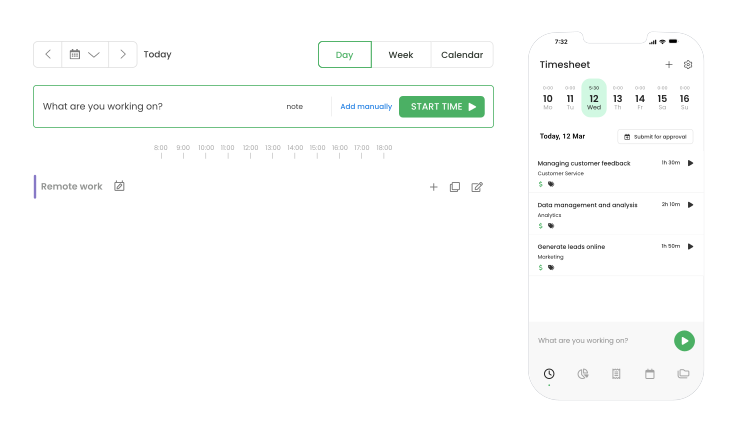
TimeCamp is time tracking software that records work hours automatically and turns them into timesheets, reports, invoices and payroll-ready data. For HR teams, it accrues PTO from your policy after every pay period, applies carryover and caps, and shows each employee their own balance. No spreadsheets, no manual recalculation.
See the vacation tracker and time off management in TimeCamp.
PTO accrual FAQs
How do you calculate PTO accrual?
Divide the yearly PTO allowance in hours by the number of pay periods in a year. For example, 15 days at 8 hours a day is 120 hours, and 120 ÷ 26 biweekly pay periods = 4.62 hours per paycheck. If your policy is based on hours worked, multiply hours worked by the accrual rate, such as 1 hour of PTO for every 30 hours worked.
How many hours of PTO do I accrue per pay period?
It depends on your annual allowance and how often you are paid. With 15 days (120 hours) a year you accrue 2.31 hours per weekly paycheck, 4.62 hours biweekly, 5.00 hours semi-monthly and 10.00 hours monthly. With 10 days (80 hours) a year, a biweekly paycheck adds 3.08 hours.
What is a good PTO accrual rate?
BLS data for March 2026 shows private industry workers get 11 paid vacation days on average after 1 year of service and 20 days after 20 years. At 8 hours a day, 11 days is 88 hours a year: 3.38 hours per biweekly paycheck, or about 0.0423 hours per hour worked on a 2,080-hour year. Paid holidays and sick leave usually come on top.
How long does it take to accrue 40 hours of PTO?
At the common rate of 1 hour of PTO for every 30 hours worked, you need 1,200 hours of work to accrue 40 hours of PTO. That is 30 weeks at 40 hours a week, or 40 weeks at 30 hours a week. At 15 days a year paid biweekly (4.62 hours per paycheck), 40 hours takes about 9 paychecks, or 18 weeks.
How much PTO do you accrue for 40 hours?
At 1 hour per 30 hours worked, 40 hours of work earns 1.33 hours of PTO. On a policy of 15 days (120 hours) a year for a full-time 2,080-hour year, 40 hours of work earns 2.31 hours of PTO. Multiply the hours worked by your accrual rate to get your own number.
What is the difference between PTO and vacation?
Vacation time is paid leave meant for rest and travel, usually kept separate from sick days and personal days. PTO (paid time off) is one combined bank that covers vacation, illness and personal needs, so employees decide how to use it. In states with a paid sick leave law, a PTO bank usually has to meet that law’s accrual, carryover and use rules.
Do part-time employees accrue PTO?
Under state paid sick leave laws, part-time employees generally accrue sick leave at the same rate as full-time staff, for example 1 hour for every 30 hours worked. Vacation and general PTO for part-timers depend on company policy; many employers prorate it by hours. A 20-hour-a-week employee at 1 hour per 30 hours accrues 0.67 hours a week, or 34.67 hours a year.
Is PTO paid out when you quit?
There is no federal requirement to pay out unused PTO when you quit. Some states, including California, Colorado, Massachusetts, Montana and Nebraska, treat earned vacation as wages that must be paid at separation; others follow the employer’s written policy. Payout is unused hours × hourly rate, so 40 hours at $25 is $1,000.00 before taxes.

Let PTO balances update themselves.
Join 18,000+ teams that track work hours, time off and PTO accruals in one place, with payroll-ready data at the end of every period.
 Google
 Apple
14 days for freeNo credit card required
user reviews4.7G2user reviews4.7user reviews4.7


